
Bright minds flood to Adelaide for hottest ticket in brain research
03 Mar 2026
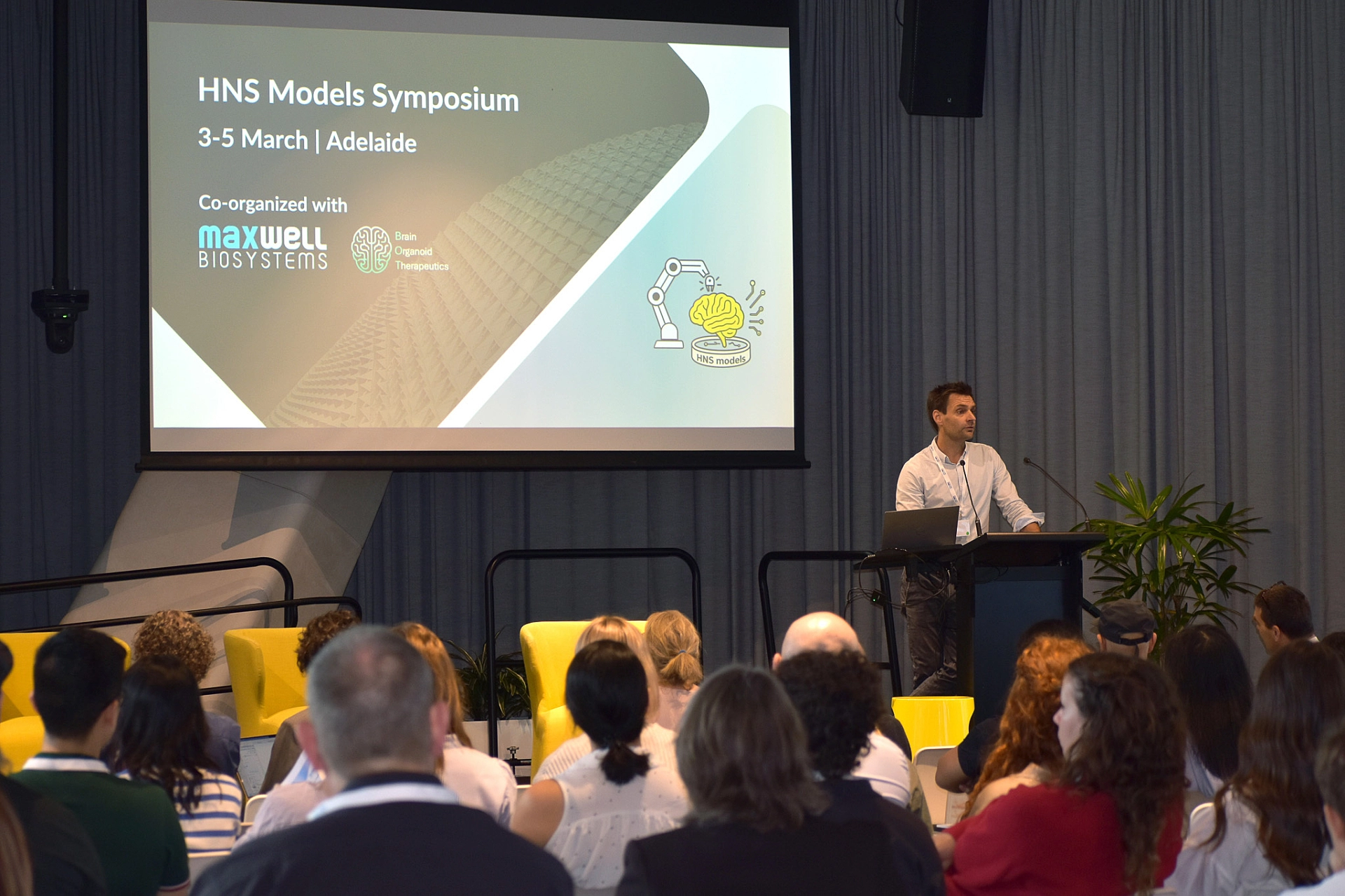
South Australia is taking centre stage as a global hub for neuroscience research and translation this week, as some of the world’s most accomplished neuroscientists gather in Adelaide for the Human Nervous System (HNS) Symposium Australia 2026.
Hosted at the South Australian Health and Medical Research Institute (SAHMRI), the three-day event running March 3-5 brings together pioneers in human nervous system modelling from across Australia and the United States.
The symposium is being coordinated by Brain Organoid Therapeutics (BOT), a local company that specialises in phenotyping and drug screening using laboratory-grown human brain tissue models.
Often referred to as “brain in a dish”, these models consist of human brain tissue grown in Petrie dishes using donated human cells, typically from skin or blood, that are reprogrammed into induced pluripotent stem cells.
These stem cells can then be guided to develop into neurons and other brain cells. Over time, they self-organise into three-dimensional structures known as brain organoids, miniature functional clusters of neural tissue that replicate key features of the human brain.
Because this tissue is grown and studied outside the body, researchers can directly observe human brain biology, measure electrical activity, examine gene expression and test how cells respond to drugs in a controlled, realistic environment.
BOT is the brainchild of Professor Cedric Bardy, a neuroscientist at SAHMRI and Flinders University, who envisioned a pipeline connecting academic researchers and industry with brain in a dish technology, to accelerate the development of new treatments.
“These are exciting times. There’s a big shift happening in medical research for neurology and psychiatry,” Prof Bardy said.
“The technology is now at a point where we’re using human models to study disease, not just animal models.”
“It’s not about replacing animal models, as human models address limitations that animals cannot, and vice versa. It’s about building a more complete approach to medical research that translates more effectively.”
The foundations of this advancement trace back to the discovery of induced pluripotent stem cells in 2007, which made it possible to reprogram adult cells into stem cells capable of forming human tissues.
Professor Bardy says the first decade centred on proving the technology worked and making it reproducible. The field has now matured, progressing to focus on clinical relevance.
“Now we’re moving into a phase where these systems are applicable to translation and patients. This symposium is about that shift and realising the potential in front of us.”
The speaker line-up reflects the scale of the event, boasting a selection of preeminent professors from leading institutes on the West Coast of the US.
Professor Fred Gage from the Salk Institute for Biological Studies in California will discuss how human neurons age and how studying them in the lab is revealing clues about dementia and other age-related brain disorders.
Professor Ed Lein from the Allen Institute for Brain Science in Seattle will explain how mapping specific brain cell types helps identify which cells are most vulnerable in disease and where future therapies should target.
Associate Professor Tomasz Nowakowski from the University of California, San Francisco will share how advanced genetic tools are being used to better understand psychiatric disorders.
Professor Bardy says attracting this calibre of expertise to Adelaide reflects the state’s growing reputation in neuroscience.
“Bringing these leaders here shows that Adelaide is at the forefront of this shift in neuroscience and neurology,” he said.
“South Australia is helping to shape the future of how we model and treat brain disorders and we should be very proud of that.”
The first two days will feature scientific presentations and poster sessions, with a third day dedicated to hands-on workshops in Professor Bardy’s laboratory, allowing students and researchers from around the world to learn cutting-edge techniques directly.
The event is free and open to the broader community.
Donate to support research at SAHMRI
Click hereRelated Articles

SAHMRI is located on Kaurna Country. We pay respects to the Kaurna people of the Adelaide Plains and to all Aboriginal and Torres Strait Islander people. We are committed to embracing knowledge and culture as we continue our working journey to incorporate Aboriginal health research across all of our themes and further reconciliation.
Read more"Tirki nguta tappa tangka marninithi"
(Learning and knowledge are the pathway to alter the mind)
- Uncle Lewis Yerloburka O’Brien, Kaurna Elder