Discovery Circle invests in vision to bring portable MRI brain scans to regional South Australia
05 Nov 2026
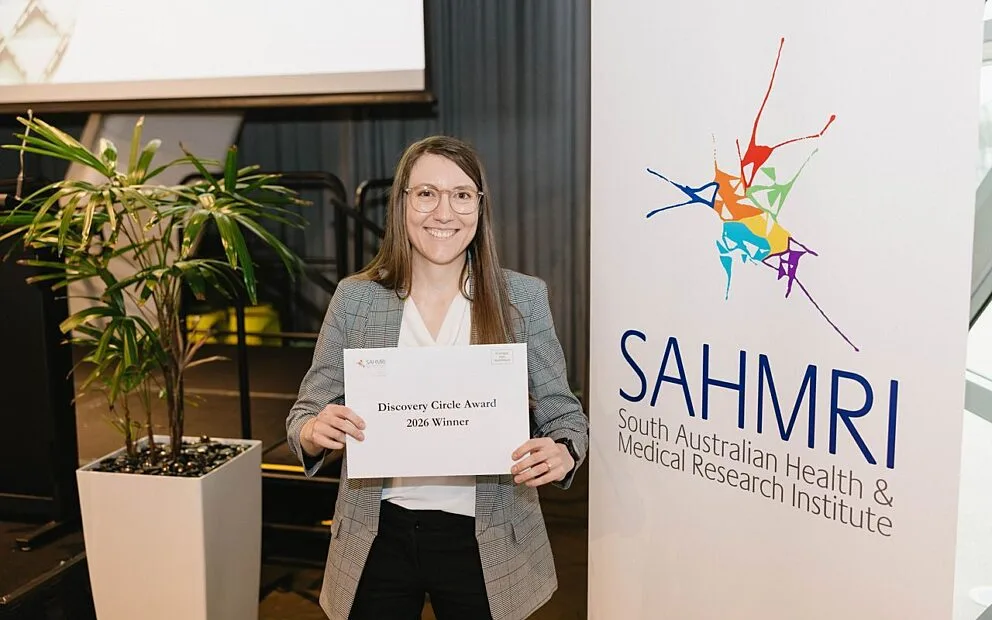
An ambitious research project aiming to improve dementia risk detection and expand access to advanced brain imaging across regional South Australia has won the support of SAHMRI's Discovery Circle donors.
Dr Sabrina Sghirripa, a Post-Doctoral Fellow in Data Science and Low Field MRI at SAHMRI's Clinical and Research Imaging Centre (CRIC), was voted the winner of the 2026 Discovery Circle Award.
The project will evaluate an ultra-low-field MRI scanner capable of detecting changes in the brain's white matter, which is associated with an increased risk of vascular dementia. Researchers will assess whether the technology can provide clinically meaningful information in people who may be at elevated risk but are not yet experiencing symptoms.
"Research suggests nearly half of all dementia cases worldwide could be delayed or prevented by addressing risk factors that we can control," Dr Sghirripa said.
While MRI is the most effective method to detect these changes, conventional scanners remain extremely costly. A standard MRI typically costs between $2.3 million and $4.5 million to purchase and install, requires purpose-built shielded facilities and specialist staff, and costs around $130,000 a year to operate. By comparison, the portable ultra-low-field MRI scanner being assessed through the project costs approximately $450,000 and around $30,000 annually to run. It can be transported between locations, plugged into a standard power outlet and operated without many of the infrastructure requirements associated with traditional MRI systems.
These differences could help address one of the greatest barriers to equitable access to advanced imaging across South Australia.
"There is no MRI north of Whyalla in South Australia," Dr Sghirripa said.
"People in rural and remote communities face greater cardiovascular risk and therefore a greater risk of dementia and have far less access to medical imaging."
Funding for the award is provided by SAHMRI's Discovery Circle, a community of donors who each contribute $5,000 annually to help advance promising research and foster the next generation of health and medical research leaders.
SAHMRI Executive Director Professor Deb White says Discovery Circle support can have a lasting impact on researchers at a pivotal stage of their careers.
"For many early and mid-career researchers, those vital career-launching opportunities can be very hard to come by, regardless of the merit of their work,” Prof White said.
"The Discovery Circle was created to help bridge that gap."
This year's award attracted 13 applications from researchers across SAHMRI. Following a competitive assessment process, the field was narrowed to three outstanding finalists who were invited to pitch their projects to Discovery Circle members.
Alongside the winning project, Dr Emma Solly presented research aimed at improving diabetic wound healing through targeted nanoparticle drug delivery designed to stimulate blood vessel growth in areas affected by poor blood flow. Dr Emily Shepherd outlined plans to establish a global maternal health evidence synthesis agenda, bringing together women and families, clinicians, policymakers, funders and researchers to identify evidence gaps and guide future research investment.
Professor White says all three finalists demonstrated the creativity, ambition and determination needed to tackle complex health challenges and build the next generation of research leadership at SAHMRI.
In recognition of the strength of their proposals and presentations, both Dr Solly and Dr Shepherd received $5,000 Discovery Circle finalist awards to support the continued development of their research programs.
The $100,000 prize awarded to Dr Sghirripa will allow her to study patients already attending cardiovascular imaging appointments at Jones Radiology, who will opt-in to undertake a brain scan using a portable MRI scanner, to provide useful information about vascular brain health and future dementia risk, and act as proof-of-concept in order to expand the project across regional SA.
"If it works, we could start to routinely screen the brain for early dementia changes, but also start to bring imaging to places where it's currently out of reach," Dr Sghirripa said.
Join the Discovery Circle and help launch the next research breakthrough
Learn more hereRelated Articles




SAHMRI is located on Kaurna Country. We pay respects to the Kaurna people of the Adelaide Plains and to all Aboriginal and Torres Strait Islander people. We are committed to embracing knowledge and culture as we continue our working journey to incorporate Aboriginal health research across all of our themes and further reconciliation.
Read more"Tirki nguta tappa tangka marninithi"
(Learning and knowledge are the pathway to alter the mind)
- Uncle Lewis Yerloburka O’Brien, Kaurna Elder